Ecofeast — plant based, compostable, sustainable
Naturally Made · Australia-Wide

Natural Areca Leaf Plates for Australian Events & Food Service

Naturally made disposable tableware for catering, parties, restaurants, and sustainable food service across Australia.

Fallen Naturally·Made Mindfully·Served Sustainably

Prices in AUD · Order enquiry by email · Bulk pricing for caterers & events

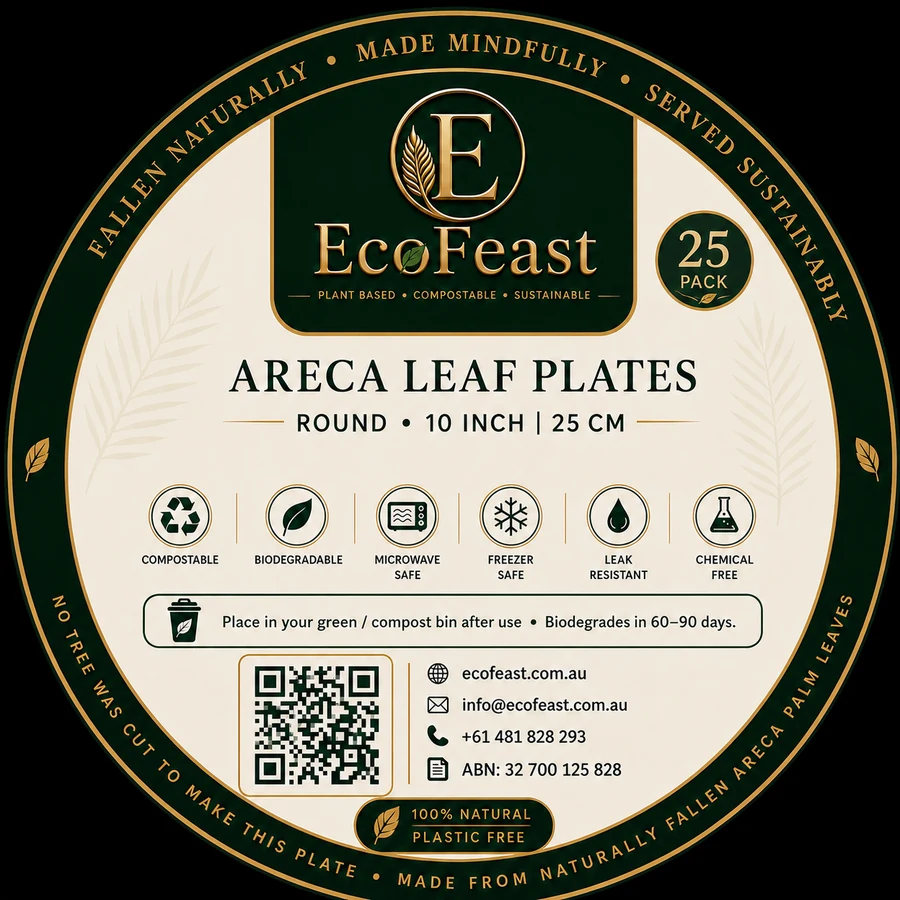
10 Inch Round Areca Plate

10 Inch Round Areca Plate

Browse the Range

Shop by category

From everyday plates to bowls and table accessories — pick the format for your table.

Why It Works

What makes a leaf plate different

An areca plate is one pressed piece of palm leaf — no coating, no binder, no plastic. That single fact is what gives it every property below.

Genuinely rigid under a full meal

The sheath's natural fibre runs in layers, so a pressed plate holds its shape under gravy, curry, a carved roast or a loaded barbecue plate. It does not go limp the way a thin paper plate does, and it does not need a second plate underneath.
Leak and oil resistant without a lining

Most disposable plates that resist liquid do it with a plastic or wax coating — which is exactly what stops them composting. Areca sheath is naturally dense enough to hold sauces and oils on its own, so nothing has to be added and nothing has to be separated later.

Microwave and freezer safe

The same heat that formed the plate means it handles a microwave reheat, and the fibre is unaffected by freezer temperatures. One plate covers serving, reheating and short-term storage.

No chemicals, dyes or plastic

Water is the only input besides heat and pressure. There is no bleach, no dye, no binder and no plastic film — so there is nothing to leach into hot food and nothing that has to be stripped out before it breaks down.

Back to soil, not landfill

Because the plate is only leaf, it composts like any other garden material — Ecofeast plates break down in roughly 60 to 90 days in an active compost. A used plate becomes soil instead of sitting in landfill for centuries.

Presentation your guests notice

Each plate carries the grain and shading of the leaf it came from, so a table set with them looks considered rather than disposable. For weddings, functions and cafés it reads as a design choice, not a cost-saving one.

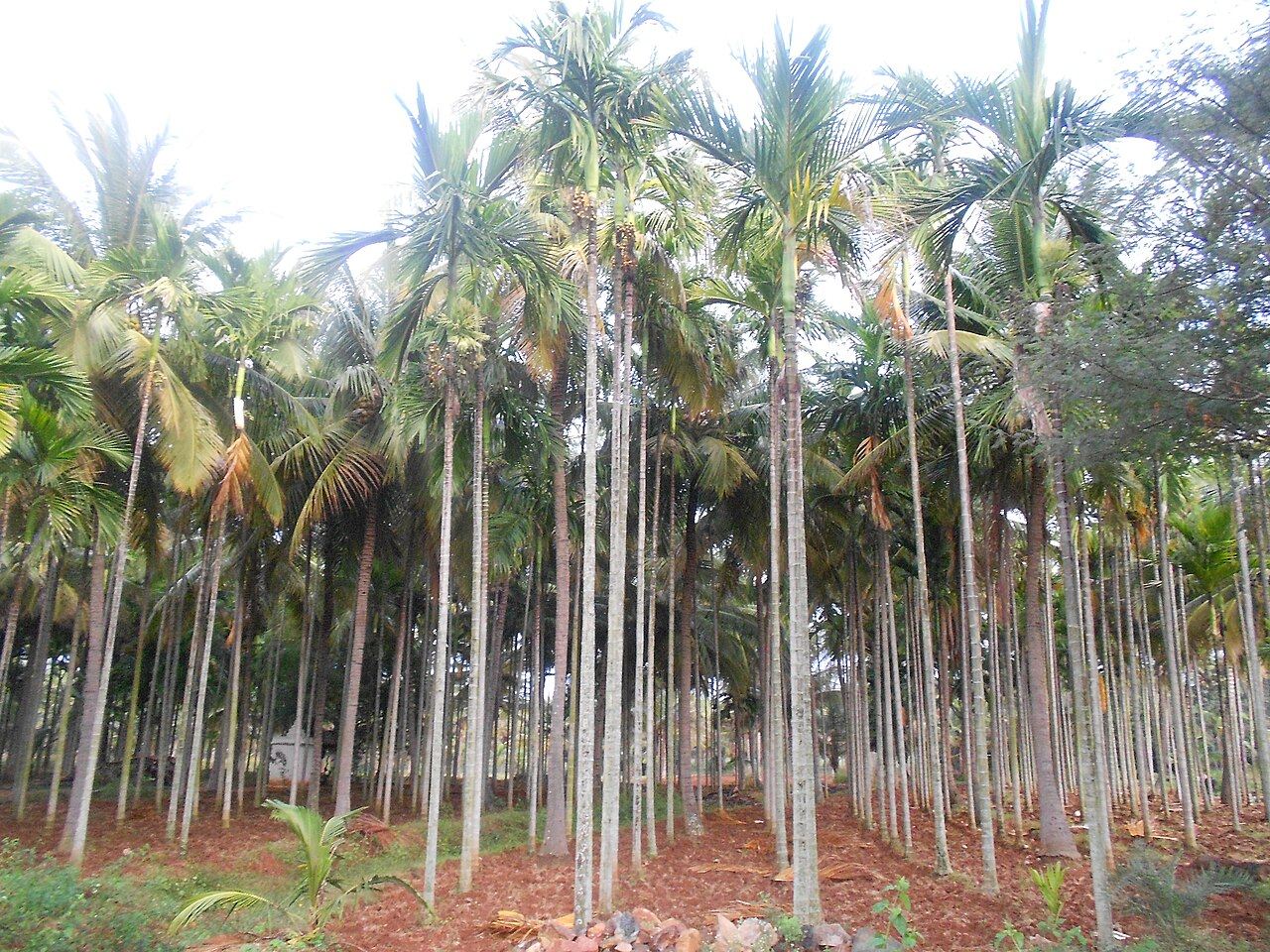
An areca nut palm plantation, the groves these leaves are gathered from

Where It Starts

No tree was cut to make this plate · Made from naturally fallen areca palm leaves

Photo: Sbblr0803 · CC BY-SA 3.0

From Grove to Table

How our plates are made

Six stages, one raw material and no chemistry. Every plate starts as a leaf sheath the palm dropped on its own — which is why we can say no tree was cut to make it.

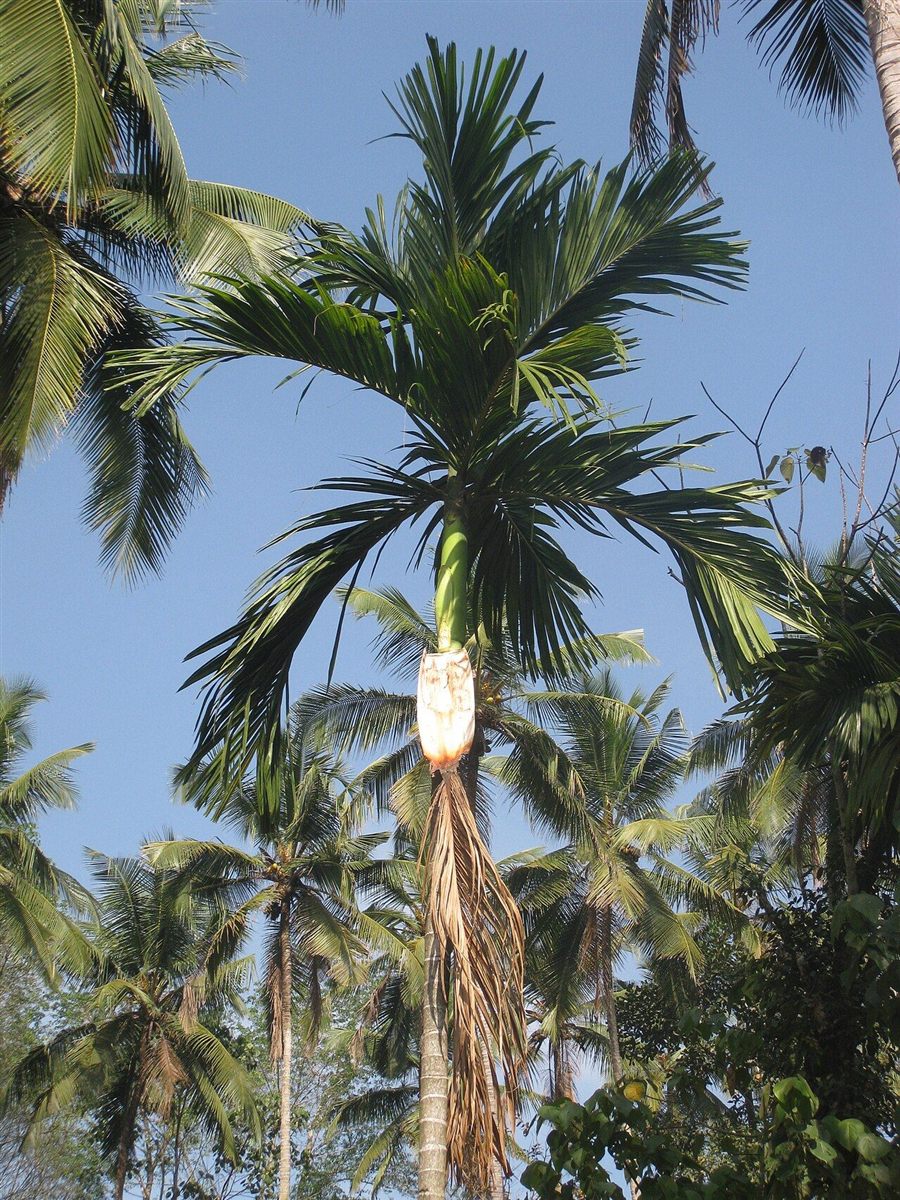
  1. An areca nut palm shedding an old leaf, the fallen sheath these plates are pressed fromZero trees felled

    Photo: Irvin calicut · CC BY-SA 3.0

    1

    Fallen leaves are collected

    Areca palms shed their leaf sheaths naturally. Growers gather the fallen sheaths from the grove floor — no tree is cut and nothing is harvested from a living palm.

    An areca palm drops several leaf sheaths every year as part of its normal growth cycle. Left alone, they simply rot on the ground. Growers collect these fallen sheaths by hand, which turns an agricultural by-product into the raw material for tableware — and gives farming families a second income from a crop they already tend.

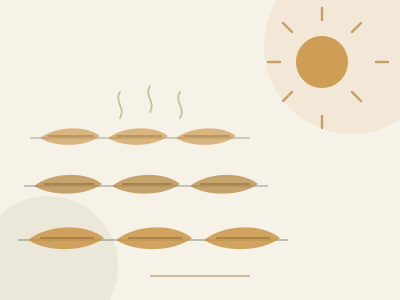
  2. The sheaths are laid out and sun-dried to draw moisture out, which prevents mould and keeps the fibre stable in storage.Air and sunlight only
    2

    Sun-dried to stabilise

    The sheaths are laid out and sun-dried to draw moisture out, which prevents mould and keeps the fibre stable in storage.

    Fresh sheaths hold a lot of water. Drying them in open air brings the moisture down so the material stays sound in transit and storage, and so it presses cleanly later. Dried sheaths are bundled and sent on to the pressing workshop.

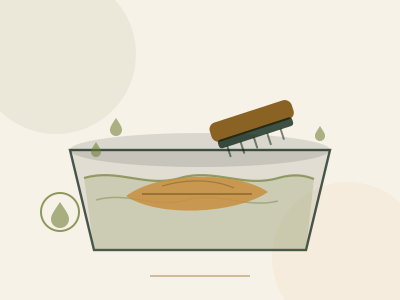
  3. Each sheath is soaked in fresh water and scrubbed by hand to lift grit and dust. Water is the only cleaning agent used.No bleach or solvents
    3

    Soaked and scrubbed in water

    Each sheath is soaked in fresh water and scrubbed by hand to lift grit and dust. Water is the only cleaning agent used.

    Before pressing, every sheath is soaked in clean water until it softens, then brushed to remove soil, sand and dust picked up off the grove floor. Softening also makes the fibre pliable enough to take a shape. No bleach, solvent or surfactant is introduced at this stage — or at any stage.

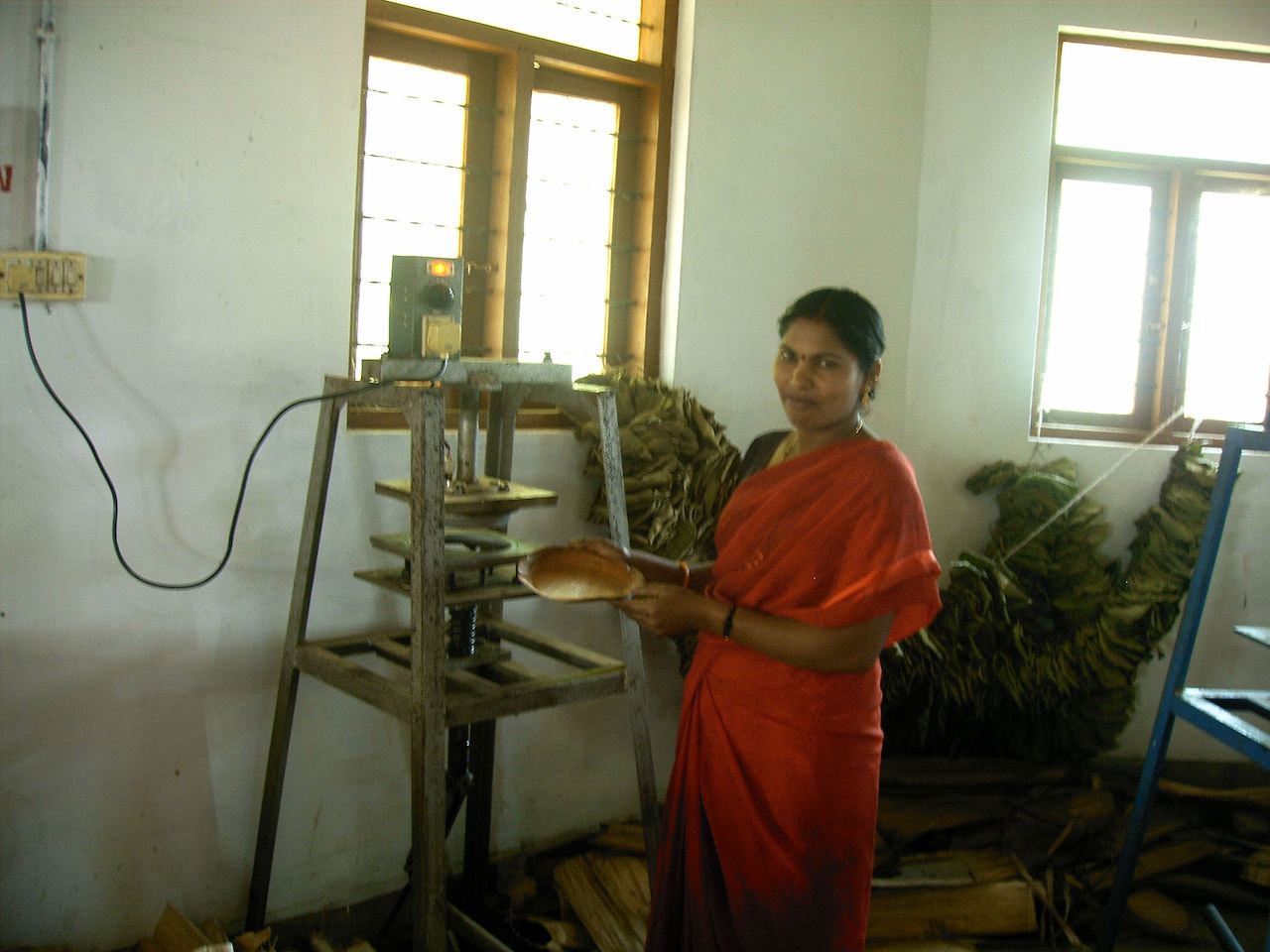
  4. An areca leaf plate pressing machine, which forms the softened sheath under heat≈180°C, no additives

    Photo: Prashanthns · CC BY-SA 4.0

    4

    Heat-pressed into shape

    The softened sheath is pressed between heated dies at roughly 180°C, which forms the plate and sterilises the material in the same action.

    A hydraulic press closes two heated moulds around the damp sheath. Heat and pressure together set the plate's shape permanently and drive off the remaining moisture. The temperature involved also sterilises the surface as it forms. Nothing is added — no glue, binder, wax or plastic lining. The plate is one continuous piece of leaf.

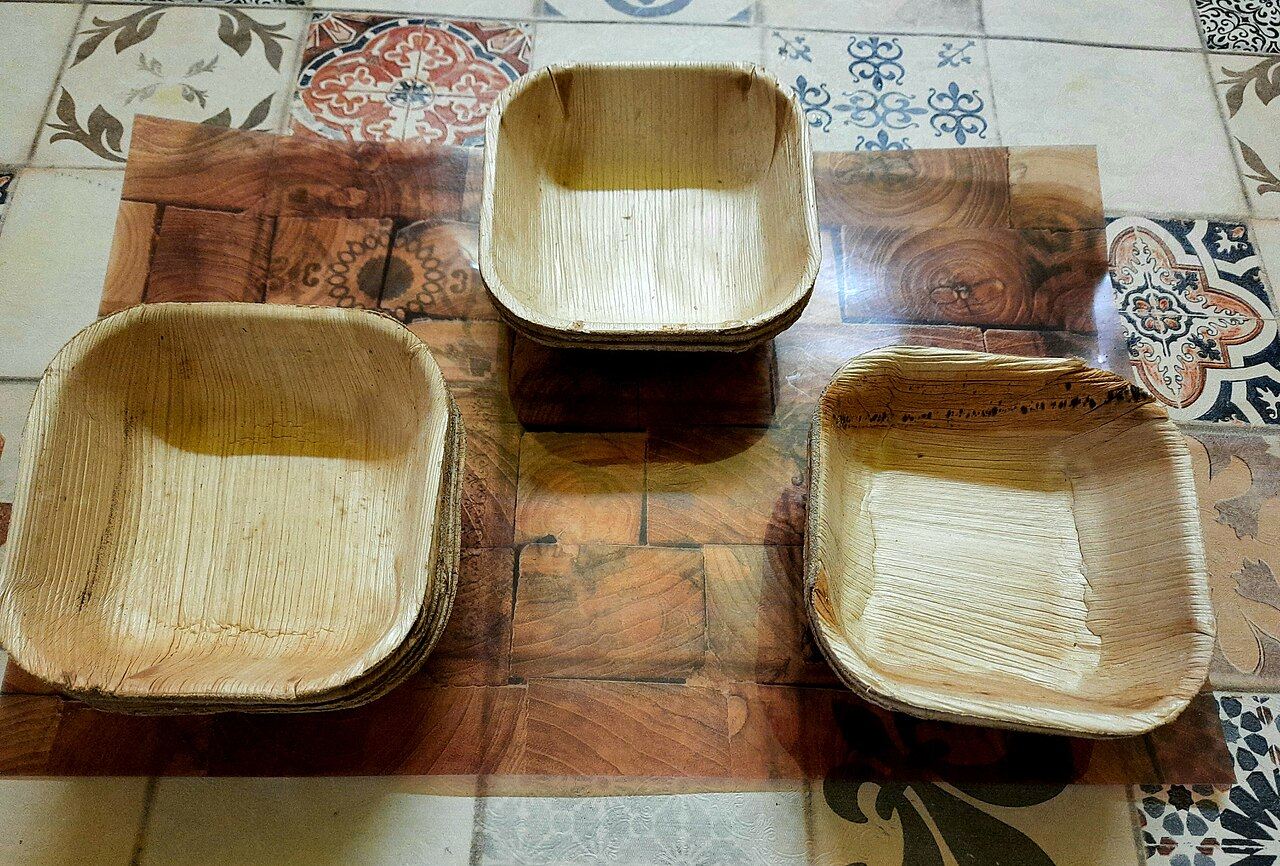
  5. A finished areca leaf plate showing the natural grain and shading of the leafChecked one by one

    Photo: Rumi Borah · CC BY-SA 4.0

    5

    Trimmed, sorted and inspected

    Edges are trimmed clean, then every plate is checked by hand for cracks, pinholes, warping and finish before it can be packed.

    Pressing leaves a rough edge, which is trimmed to the finished profile. Each plate is then handled and inspected individually: held to the light for pinholes, flexed for hairline cracks, checked for a flat base that will not rock on a table, and sorted by shade. Anything that fails goes back to compost rather than into a pack.

  6. Finished plates are counted into packs and sealed with the moisture kept low, so they arrive rigid and ready to use.Sealed against humidity
    6

    Sealed dry and shipped

    Finished plates are counted into packs and sealed with the moisture kept low, so they arrive rigid and ready to use.

    Because the finished plate is a natural fibre, moisture is the one thing that will soften it in storage. Packs are sealed to keep humidity out and stacked to protect the rims in transit. From there they ship to our Australian customers — in retail packs for households and events, or in bulk cartons for caterers and food service.

The whole process uses water, sunlight, heat and pressure. Nothing else goes in, so nothing else has to come out at the end of the plate's life.

Quality Control

What we check before a pack ships

Natural material means natural variation — so inspection is done plate by plate, not by sampling a carton.

Food-contact safe by composition

There is no coating, dye or adhesive to migrate into food, because none is ever applied. The finished plate is the same material as the leaf it was pressed from.

Held to the light for pinholes

Every plate is checked against light so thin spots and pinholes are caught before packing — the defects most likely to leak under a wet meal.

Flexed for hairline cracks

Plates are flexed by hand at the rim and base. A pressed sheath that was too dry will craze, and those are pulled out of the run.

Flat base, stable rim

A plate that rocks on a table fails inspection. Bases are checked flat and rims checked even so plates stack cleanly and sit steady in a guest's hand.

Sorted for shade and grain

Natural leaf varies from pale honey to deep brown. Packs are sorted so the plates on one table read as a set rather than a mismatch.

Sealed at low moisture

Packs are sealed dry. Moisture is the one thing that softens a natural-fibre plate in storage, so humidity is kept out from the workshop to your door.

On Every Label

Six assurances, every order

  • Compostable
  • Biodegradable
  • Microwave Safe
  • Freezer Safe
  • Leak Resistant
  • Chemical Free

Side by Side

Areca leaf vs the other disposables

How the common options compare on the things that actually matter at a table — and what happens to each one afterwards.

Areca leaf tableware compared with plastic, coated paper, bagasse and bamboo
MaterialStrengthLiquids & oilMicrowaveAfter use
Areca leaf (Ecofeast)Rigid — holds a full mealNaturally resistant, no liningYesComposts in ~60–90 days
Plastic / polystyreneRigid but brittleResistantVaries, often unsafePersists for centuries; many types now restricted in Australia
Coated paper / cardFlexible — often needs doublingOnly via a plastic or wax liningVaries by coatingLining must separate before it can compost
Bagasse (sugarcane pulp)FirmGood, sometimes coatedYesCompostable, usually commercial facilities
Bamboo / wood veneerFirmModerateUsually notCompostable if uncoated

Coated paper and bagasse products vary by supplier — check the specification of any individual product against its own documentation.

Best Sellers

Featured products

View all products

Who Uses Them

Made for Australian tables

Retail packs for the household, bulk cartons for the ones feeding a few hundred people.

Weddings & functions

Table settings that look intentional, with no washing-up at the end of the night and no bin bag of plastic.

Caterers & food trucks

Rigid enough to carry a full plate standing up, in sizes and pack quantities that suit a service run.

Cafés & restaurants

A takeaway and dine-in option that matches a sustainability policy without a drop in presentation.

Home & family gatherings

Barbecues, birthdays and festivals — sturdy under real food, and straight into the compost bin afterwards.

After the Meal

Straight into the compost

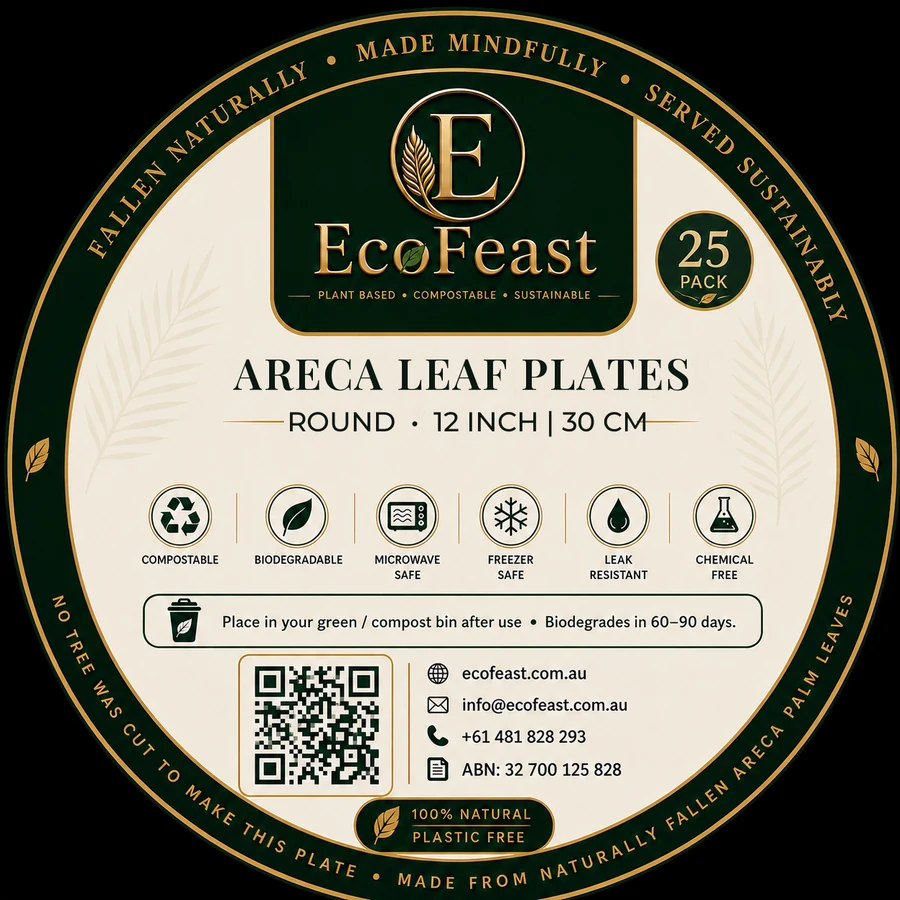
Place in your green / compost bin after use · Biodegrades in 60–90 days.

Australia recognises two composting standards — AS 5810 for home composting and AS 4736 for commercial facilities. Councils differ on what they accept in FOGO and green bin collections, so it is worth checking your local guidance. In a home compost or worm farm, tear the plate up first and it will break down faster.

  • 1Scrape off heavy food waste
  • 2Tear into a few pieces
  • 3Into the compost or green bin
  • 4Soil in about 60–90 days

Joining the Range

Coming soon

Register your interest and we'll let you know the moment these launch.

Questions

Frequently asked questions

The things Australian customers ask most about areca leaf tableware — material, performance, delivery and disposal.

What are areca leaf plates made from?

They are made from the leaf sheath of the areca palm, which the tree sheds naturally each year. The fallen sheath is collected, dried, washed in water and pressed into shape with heat. No tree is cut down, and nothing is added — no plastic, wax, glue, bleach or dye. The finished plate is a single piece of leaf.

Are areca leaf plates really compostable in Australia?

Yes — the plate is plain leaf fibre with no plastic lining, so it breaks down like any other garden material, typically in about 60 to 90 days in an active compost. Australia recognises two composting standards: AS 5810 for home composting and AS 4736 for commercial facilities. Councils differ on what they accept in FOGO and green-bin collections, so check your council's guidance before putting them in a kerbside bin. In a home compost or worm farm they can go straight in, ideally torn into pieces first.

Can I put areca leaf plates in the microwave?

Yes. The plates are formed under heat of roughly 180°C, so a microwave reheat is well within what the material handles. Around two minutes is a sensible maximum for a normal serving. They are also freezer safe. They are not designed for oven or open-flame use.

Will they leak with curry, gravy or oily food?

No. The areca sheath is naturally dense enough to hold sauces and oils without any coating, which is what separates it from paper plates that need a plastic or wax lining to do the same job. Wet, oily and hot dishes are exactly the use case these plates were made for.

Are they strong enough for a full meal?

Yes. The fibre runs in natural layers, so a pressed plate stays rigid under a loaded serving — a carved roast, a full barbecue plate or a curry and rice. Guests can hold one in the hand standing up without it folding, and you do not need to double-plate the way you would with thin paper.

Does the plate affect the taste or smell of food?

No. Because nothing is applied to the leaf, there is no coating or chemical to transfer. The plates have a very faint natural scent when a pack is first opened, which does not carry into food.

Will every plate look the same?

Not exactly, and that is the nature of the material. Each plate carries the grain and shading of the leaf it was pressed from, so colour ranges from pale honey to deeper brown and no two are identical. We sort packs by shade so the plates on one table read as a set.

What sizes and formats do you stock?

Our range covers round plates, square plates, compartment plates, bowls and trays in the sizes most used for Australian catering and events, plus bulk packs for volume orders. You can see current sizes, pack quantities and stock on the products page.

Do you deliver across Australia, and what does freight cost?

Yes, we deliver Australia-wide. Freight is quoted per order because it depends on volume and destination, and we confirm the cost and timing with you before any payment is made — there is no surprise shipping charge at the end.

Can I get bulk pricing for a wedding, restaurant or event?

Yes. Bulk and catering pricing is quoted directly. Send us the sizes, quantities and your event or delivery date through the bulk quote form and we will come back with pricing, freight and lead time confirmed together.

How should I store them before an event?

Keep them sealed and somewhere dry. Moisture is the only thing that softens a natural-fibre plate, so avoid damp cupboards, garages and anywhere with condensation. Stored dry, they keep indefinitely without degrading.

How do I dispose of them after use?

Put them in your compost or green bin where your council allows it — Ecofeast plates break down in roughly 60 to 90 days. Scraping off heavy food waste and tearing the plate into a few pieces speeds it up. If composting is not available to you, they can go in general waste, where they still break down as plant matter rather than persisting as plastic.

Still deciding? Send us your question — we answer every enquiry personally.

Bulk & Catering

Need pricing for restaurants, caterers or events?

Tell us your sizes, quantities and event date. We'll put together a bulk quote with freight and timing confirmed before you pay.

WhatsApp usCall +61 481 828 293